The Ultimate Mount Bromo Astrophotography Expedition: A 2026 Masterclass Guide
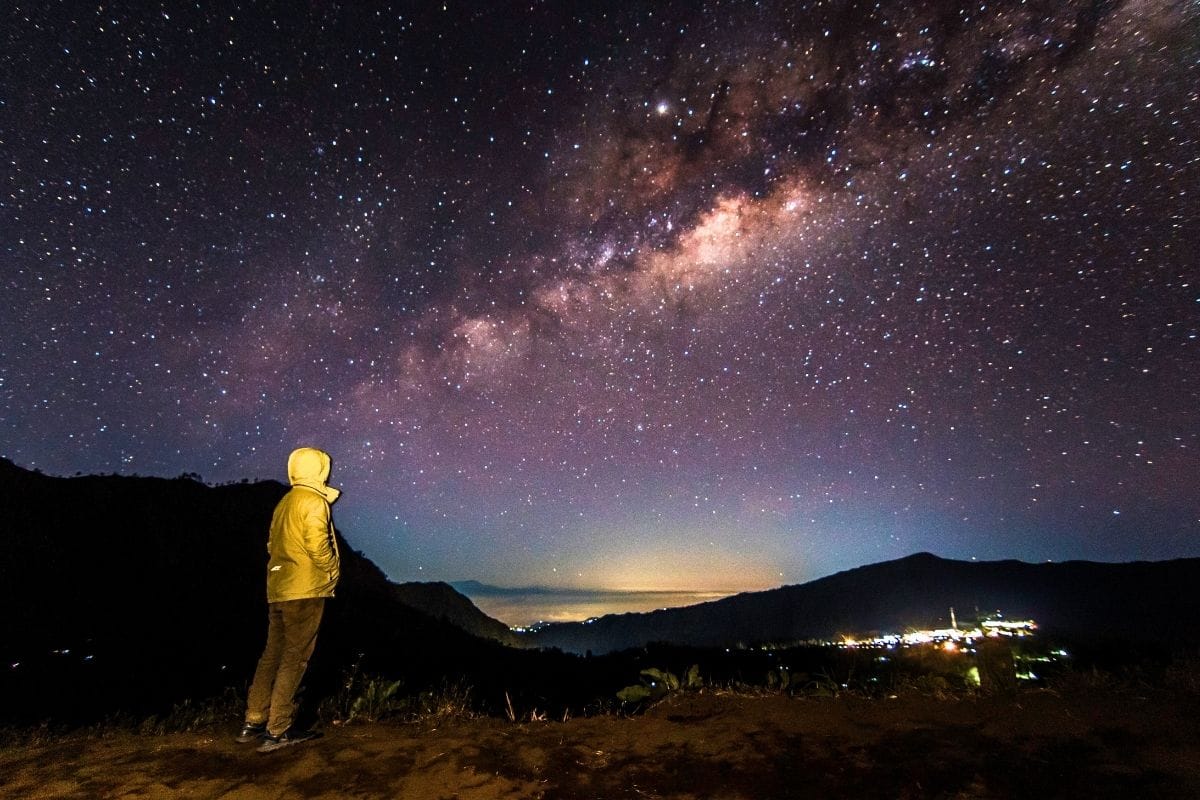
The Mount Bromo Astrophotography expedition is a specialized photography trip designed to capture the Galactic Center of the Milky Way rising over Indonesia’s most iconic volcanic landscape. To achieve world-class results, photographers must synchronize their visit with the April–September dry season, utilizing advanced long-exposure techniques and expert local navigation.
For any serious landscape or night-sky photographer, a journey to the Tengger Semeru National Park is a rite of passage. While thousands flock to the crater for sunrise, the true magic occurs in the silent, freezing hours of the lunar-dark night. Whether you are an international backpacker looking for that one “hero shot” or a luxury traveler seeking a curated, high-end Mount Bromo tour, understanding the technical and logistical nuances of the 2026 landscape is essential for success.
Why Trust This Astrophotography Guide?
In the rapidly evolving landscape of Indonesian tourism, information from 2023 or 2024 is already obsolete. Our team at Ijen Expedition has spent over a decade leading specialized photography workshops across East Java. We understand that astrophotography isn’t just about showing up; it’s about understanding atmospheric transparency, light pollution maps, and the specific volcanic activity levels of 2026.
This guide is built on real-world data from our most recent 2025 expeditions. We provide the latest 2026 pricing for permits, updated drone regulations, and the specific technical settings required to cut through the volcanic haze that often plagues amateur shots. When you book with us, you aren’t just hiring a driver; you are gaining access to scouts who know exactly where the galactic core will align with the Mount Batok and Mount Bromo peaks.
What You Need to Know
- Best Season: April to September (The Dry Season).
- 2026 Entrance Fees: Approximately IDR 750,000 – 900,000 for foreigners (specialized photo permits may apply).
- Core Visibility: The Milky Way core is most prominent from 11:00 PM to 4:00 AM during these months.
- Mandatory Gear: Full-frame DSLR/Mirrorless, f/2.8 or faster wide-angle lens, and a heavy-duty tripod for high winds.
- Booking: Online registration is mandatory via the official national park portal at least 2 weeks in advance.
Table of Contents
1. Celestial Mechanics: When to Visit in 2026
Astrophotography is a slave to the lunar cycle. To capture the stars in their full glory, you must plan your expedition around the New Moon phase. In 2026, the galactic core is visible in the southern sky, rising earlier as the season progresses. Attempting this during a Full Moon will result in washed-out skies where the faint nebulosity of the Milky Way is invisible to the sensor.
The “Dry Season” in East Java typically runs from late April to early October. However, 2026 climate patterns suggest that the “shoulder months” of May and June offer the clearest atmospheric conditions before the dust of the late dry season creates a persistent haze in the caldera. During these months, the air is crisp, and the transparency is at its peak, allowing for incredible detail in the Rho Ophiuchi cloud complex.
Timing your shoot also involves understanding the “Blue Hour” transition. The most coveted shots often involve a “Blue Hour” foreground blend with a “Deep Night” sky. This requires arriving at your location by 10:00 PM and staying until the first light of dawn. For those coming from East Java hubs, a Mount Bromo midnight tour from Surabaya is the most efficient way to reach the rim in time for the galactic rise.
2. Essential Gear for Volcanic Environments
Mount Bromo is a harsh environment. The sand is fine and volcanic (silica-based), which can be lethal to camera internal mechanics and lens elements. In 2026, we recommend weather-sealed bodies such as the Nikon Z9, Sony A7R V, or Canon R5. However, even entry-level mirrorless cameras can produce stunning results if paired with the right glass.
Your primary lens should be a wide-angle prime with an aperture of at least f/2.8. Popular choices include the 14-24mm f/2.8 or the 20mm f/1.8. The wider the aperture, the lower the ISO you can use, resulting in less noise. Additionally, a sturdy tripod is non-negotiable. The wind on the rim of the caldera can reach speeds that will cause micro-vibrations in lightweight travel tripods, ruining a 20-second exposure.
In 2026, volcanic ash activity has been moderate. Always wrap your camera body and lens join in a protective sleeve or simple plastic wrap secured with rubber bands. This prevents the fine “Sea of Sand” dust from entering your sensor chamber during lens changes. Never change lenses in the open; do it inside the Jeep or under a heavy coat.
3. Scouting the Best Shots: Secret Locations
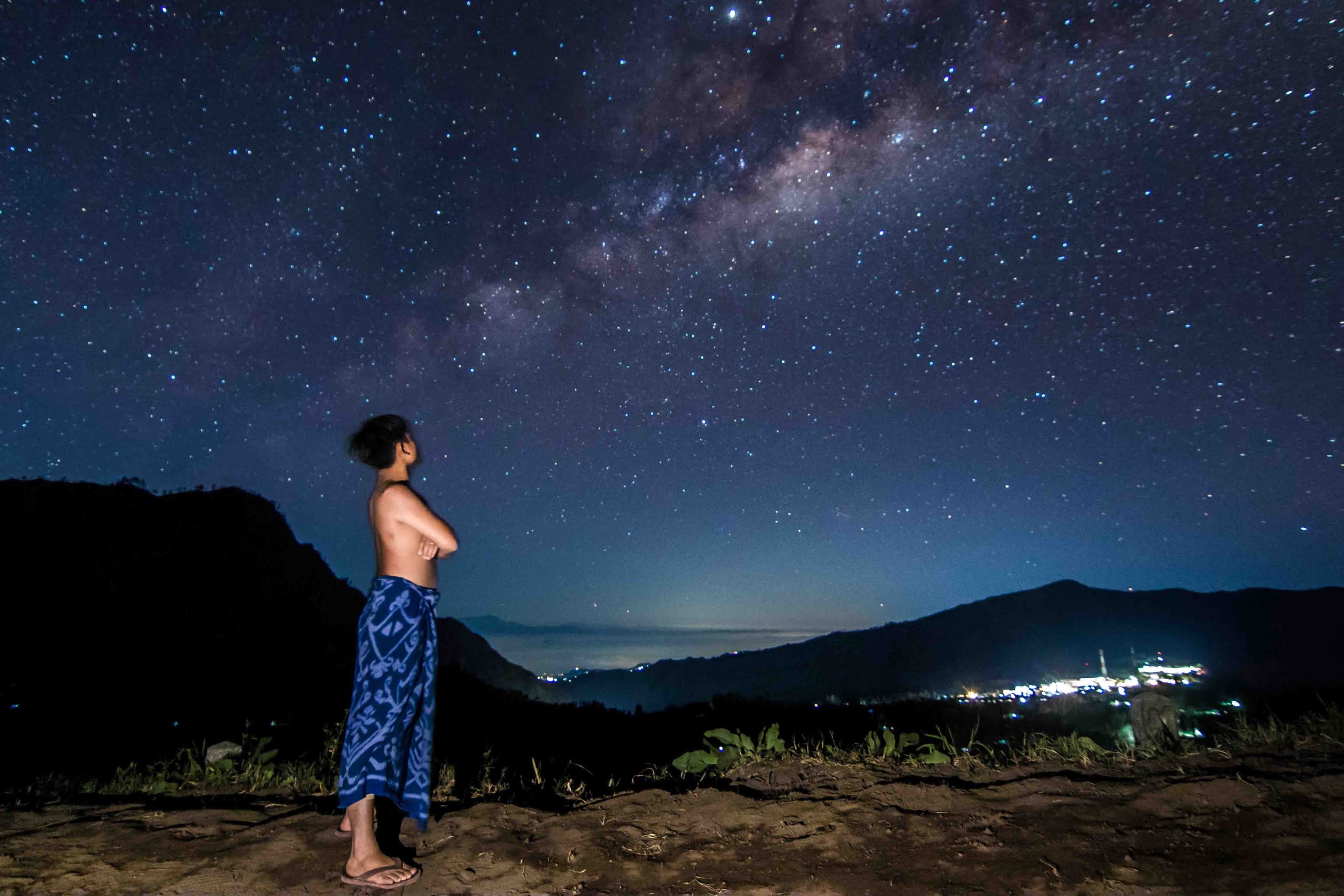
While Penanjakan 1 is the most famous viewpoint, it is often overcrowded and suffers from light pollution from the headlights of hundreds of arriving Jeeps. For a professional Mount Bromo Astrophotography expedition, we move away from the crowds. Locations like King Kong Hill and Seruni Point offer higher elevations and more dramatic angles of the Milky Way arching over the entire volcanic complex.
For those seeking a unique perspective, the “Sea of Sand” (Lautan Pasir) at the base of the volcanoes provides an otherworldly foreground. Shooting from the temple (Pura Luhur Poten) with the Milky Way directly above the smoking crater of Bromo creates a narrative of spiritual and cosmic connection. This requires a guide who can navigate the dark plains safely, as it is easy to become disoriented in the vast, featureless sand at night.
If you are extending your trip to include other wonders, such as a Bromo Tumpak Sewu Ijen Crater tour, you will find that each location offers a different “Sky Class” rating. Bromo remains the best for wide-field astro due to its 360-degree unobstructed horizons and altitude of 2,329 meters, which puts you above the thickest layer of tropical humidity.
4. Technical Mastery: Camera Settings & Post-Processing
To capture the stars as pin-points rather than streaks, you must use the “Rule of 500” or the more accurate “NPF Rule.” For a 14mm lens on a full-frame sensor, this typically means an exposure time of 20 to 25 seconds. In 2026, with the high-resolution sensors now common, even a tiny bit of trailing is visible, so we recommend slightly shorter exposures (15s) paired with a higher ISO (3200-6400).
Focusing at night is the biggest challenge for beginners. Do not rely on autofocus. Find a bright star or the distant lights of Probolinggo in your Live View, zoom in 10x, and manually adjust the focus ring until the light point is as small as possible. Take a test shot and review it at 100% zoom to ensure the stars are sharp. If your focus is off even by a millimeter, the entire night’s work will be unusable for large-format printing.
Post-processing is where the “magic” happens. Shooting in RAW is mandatory. In software like Adobe Lightroom or Capture One, you will need to adjust the White Balance to a cooler temp (approx. 3800K-4200K) to neutralize the yellow cast of light pollution. Use the “Dehaze” tool sparingly to bring out the nebulosity, and apply selective noise reduction to the sky while keeping the volcanic foreground sharp and detailed.
5. 2026 Logistics, Pricing, and Regulations
Traveling in 2026 requires more advanced planning than in previous decades. The Indonesian Ministry of Environment has implemented a strict quota system for the Bromo Tengger Semeru National Park. Tickets must be purchased online via the official booking site. There are NO on-the-spot ticket sales. For photography expeditions, ensure you select the “Photography/Research” option if you are bringing professional cinema gear or drones, as standard tourist tickets may not cover commercial usage.
| Service / Item | Estimated 2026 Price (IDR) | Notes |
|---|---|---|
| Foreigner Entrance Fee | IDR 750k – 900k | Includes insurance; Weekends are higher. |
| Private 4WD Jeep Rental | IDR 1.2M – 1.8M | Price for photography-specific timing (10 PM – 10 AM). |
| Drone Permit (Professional) | IDR 2.5M – 5M | Required for any flight within the park. |
| Photography Guide | IDR 1.5M – 2.5M | Specialized in astrophotography locations. |
Regarding drone use: In 2026, the park rangers are extremely strict. All drones must be registered with the Indonesian Civil Aviation Authority (DKPPU) and have a specific park permit. Unauthorized flying can result in heavy fines and confiscation of gear. If you are serious about aerial astrophotography, our team can help facilitate these permits well in advance of your arrival.
Related Photography Tour Packages
If you are looking to maximize your time in Indonesia, consider these expertly curated itineraries that complement the Bromo astrophotography experience:
- Standard Mount Bromo Sunrise Tour – The classic experience for those on a tighter schedule.
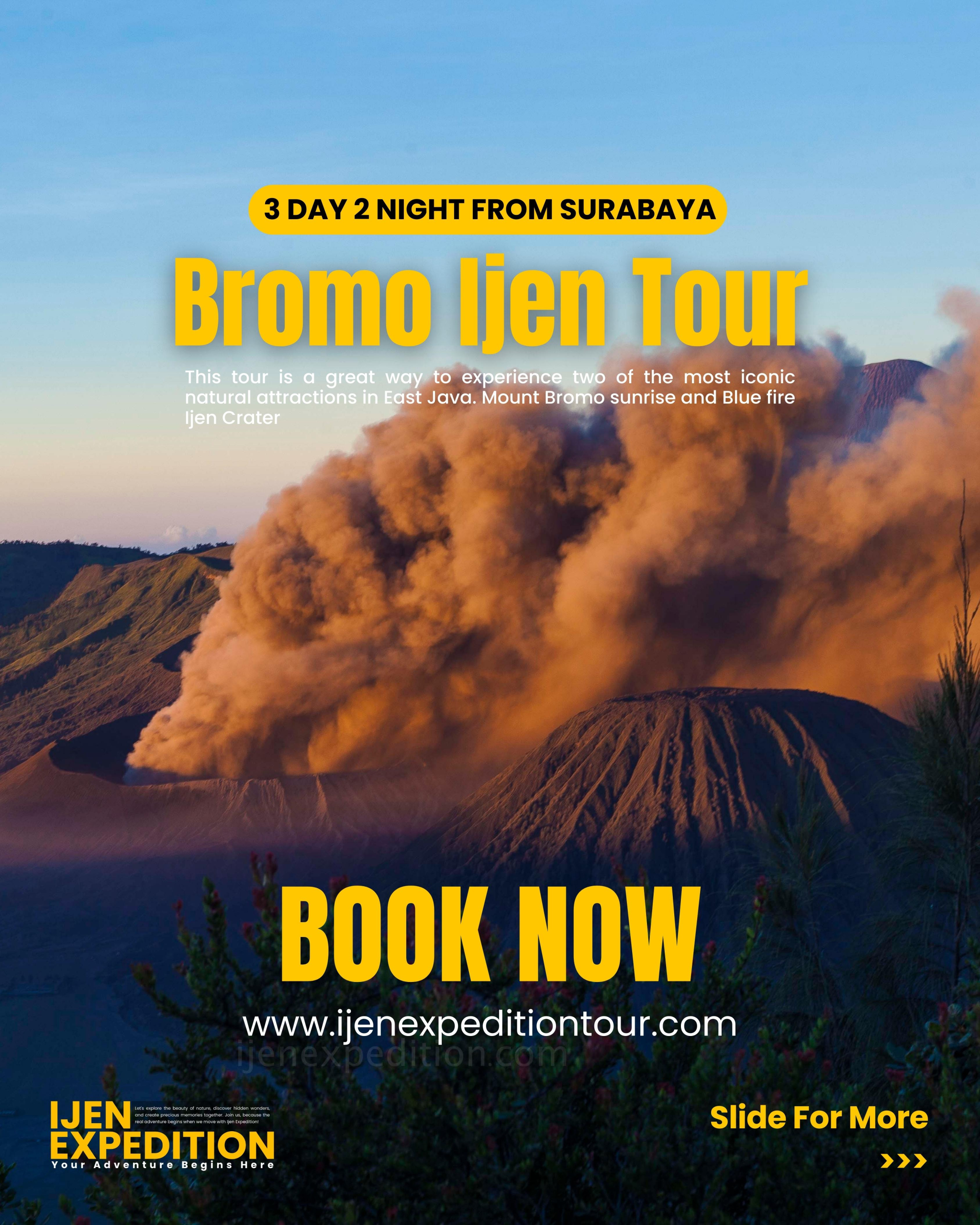
- 3-Day Bromo & Ijen Volcano Combo – Capture the Blue Fire of Ijen and the Milky Way of Bromo in one trip.
- Midnight Bromo Express – Ideal for travelers arriving late into Surabaya who want to head straight to the stars.
Ready for Your Adventure?
The stars over the Tengger caldera are waiting for no one. Whether you are a professional looking for the ultimate portfolio piece or a hobbyist wanting to learn the ropes of night photography, our specialized expeditions provide the logistics, security, and expertise you need. Don’t leave your once-in-a-lifetime shots to chance—book your 2026 expedition with the local experts today.
Book Your Photography Trip Now
WhatsApp: +6285748711646 |
📧 Email: ijenexpeditiontourandtravel@gmail.com
Frequently Asked Questions (FAQ)
Q: What is the best month for Bromo astrophotography in 2026?
A: The absolute best window is between June and August 2026. This period offers the highest probability of clear skies and the most optimal positioning of the Milky Way’s galactic core directly over the volcanoes.
Q: Do I need a special permit for photography at Mount Bromo?
A: For personal hobbyist photography with a standard camera, a regular entrance ticket is usually sufficient. However, for commercial shoots, professional filming, or drone usage, you MUST obtain a specific permit (SIMAKSI) which carries a significantly higher fee in 2026.
Q: How cold does it get at night during the expedition?
A: Temperatures at the viewpoints can drop to 0°C – 5°C (32°F – 41°F) between midnight and dawn. Due to high winds, the wind chill factor can make it feel much colder. Heavy winter gear, gloves, and thermal layers are essential.
Q: Can I use a drone for astrophotography at Mount Bromo?
A: Yes, but with strict 2026 regulations. You need a drone permit, and flying is restricted in certain areas near the active crater for safety. Night flying also requires specialized lighting on the drone and prior approval from the park rangers.
Q: Is it safe to travel to Bromo if the volcano is active?
A: Mount Bromo is an active volcano. In 2026, the park authority (PVMBG) monitors activity daily. If the alert level rises to Level II or III, access to the crater rim is closed. However, viewpoints like Penanjakan remain open as they are a safe distance from the vent.